Microsoft 365
- Installing Microsoft 365
- Setting up OneDrive
- Meeting on Teams
- Setting up Outlook on mobile
- Encrypting messages in Outlook
- Reporting messages in Outlook
- Sharing files with OneDrive
Installing Microsoft 365
All students, faculty and staff are assigned a license to the Microsoft 365 suite of apps.
- Microsoft 365 apps can be accessed via the web at m365.cloud.microsoft/apps.
- The desktop version of Microsoft 365 apps offer more features and can be installed with the instructions in the Desktop Apps section.
- You can install Microsoft 365 apps on your Android or iOS device with the links in the Mobile Apps section.
Web apps
The Microsoft 365 web apps offer a convenient way to use Microsoft 365 in your browser.
Microsoft 365 web apps are found at m365.cloud.microsoft/apps.
Desktop apps
Desktop apps for Microsoft 365 offer the most robust features and are installed via the instructions below.
Windows
- Head to m365.cloud.microsoft/apps.
- Sign in with your campus username and password.
- Click the Install apps dropdown then Microsoft 365 apps.

- Click Install Office to download the installer.

- Open the OfficeSetup.exe installer that just downloaded.

- If prompted, allow the installer to run by clicking Yes on the User Account Control popup.
- College-owned computers will require administrator credentials to continue.
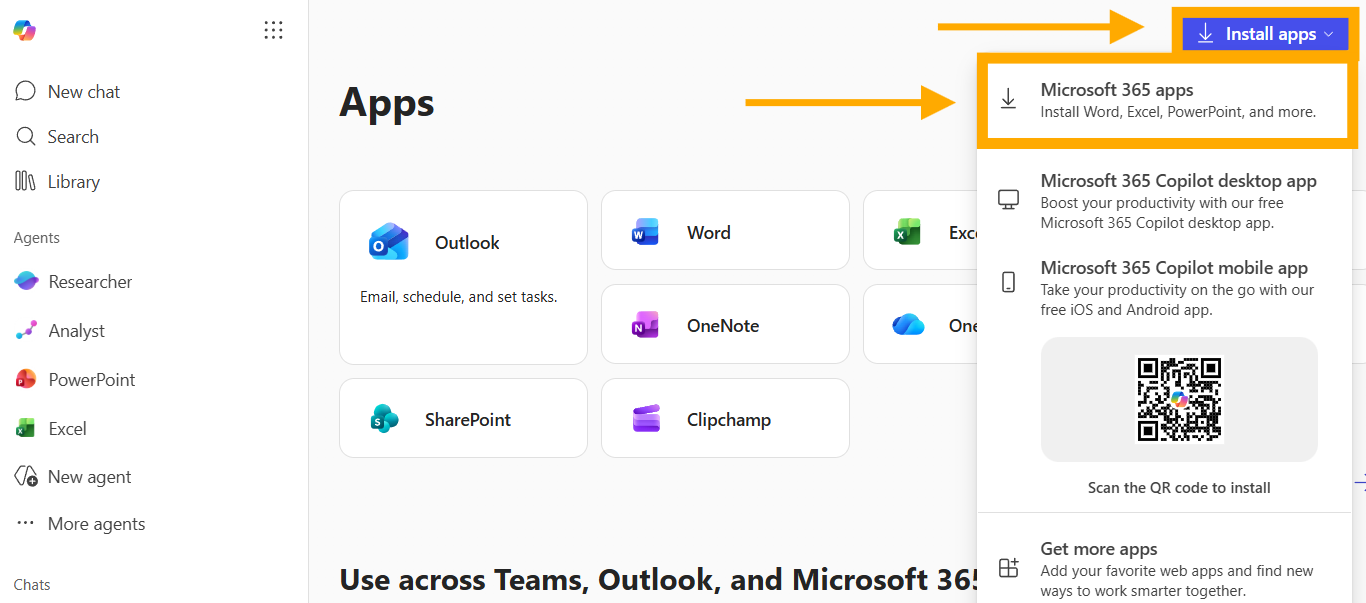
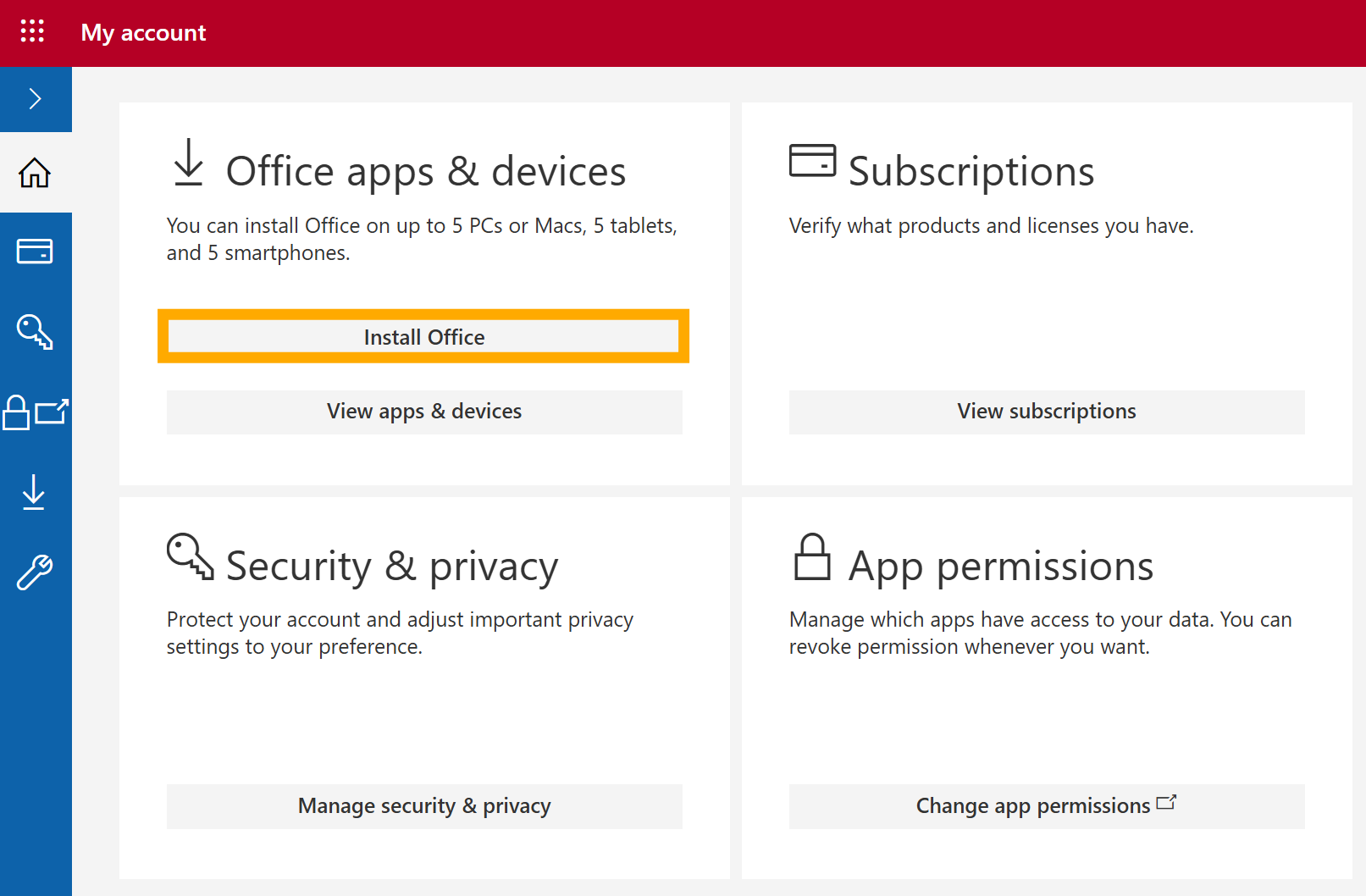
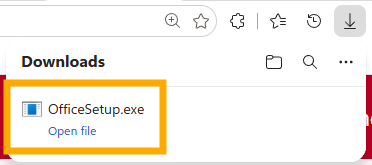
The installer will download and install the Microsoft 365 desktop apps.
macOS
- Head to m365.cloud.microsoft/apps.
- Sign in with your campus username and password.
- Click the Install apps dropdown then Microsoft 365 apps.
- Click Install Office to download the installer.
- Wait for the download to complete.
- Open Finder.
- Go to Downloads.
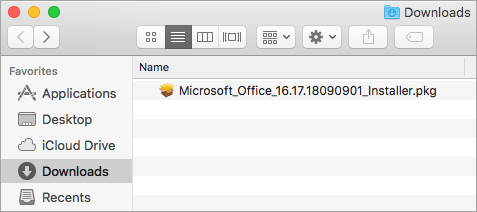
- Double-click Microsoft_365_and_Office_BusinessPro_Installer.pkg file.
File name will vary between Office versions.
If you see an error that says the Microsoft Office installer.pkg can't be opened because it is from an unidentified developer, wait 10 seconds and move the downloaded file to your desktop. Hold Control + click the file to launch the installer.
- On the first installation screen, select Continue to begin the installation process.

- Review the software license agreement, and then click Continue.
- Review the software license agreement, and then click Continue.
- Select Agree to agree to the terms of the software license agreement.
- Choose how you want to install Microsoft 365 and click Continue.
- Review the disk space requirements or change your install location, and then click Install.
If you want to only install specific Microsoft 365 apps and not the entire suite, click the Customize button and uncheck the programs you don't want.
- Enter your Mac login password, if prompted, and then click Install Software.
This is the password that you use to log in to your Mac.
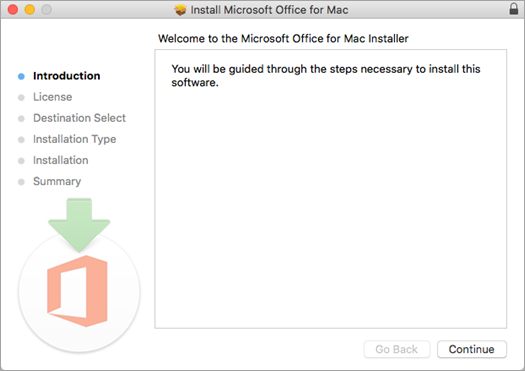
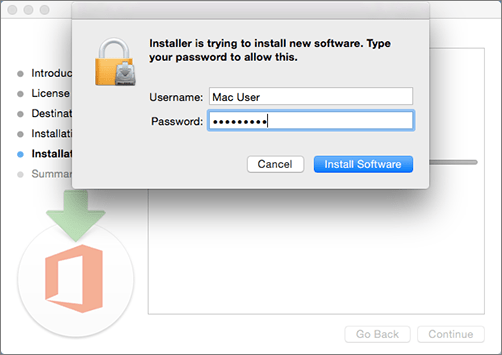
The software begins to install. Click Close when the installation is finished.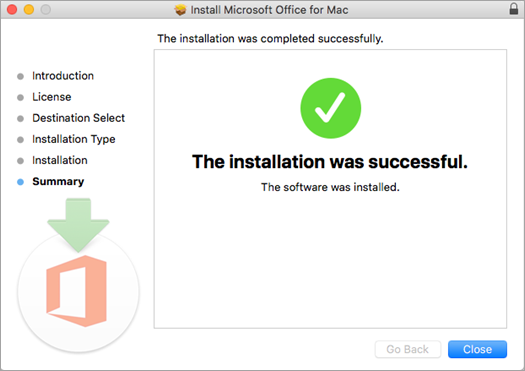
Mobile apps
Android
Microsoft 365 apps can be downloaded on Android devices via the Google Play Store
Setting up OneDrive
Microsoft OneDrive is a cloud storage solution available for everyone at Bryn Athyn College.
- With OneDrive, you can sync files between your computer and the cloud, so you can get to your files from anywhere—your computer, your mobile device, or through the OneDrive website at OneDrive.com.
- If you add, change, or delete a file or folder in your OneDrive folder, the file or folder is added, changed, or deleted on the OneDrive website and vice versa.
- You can work with your synced files directly in File Explorer in Windows or Finder in macOS. Whenever you’re online, any changes that you or others make will sync automatically. Once synced, you can access your files even when you’re offline.
Installation
Windows
- OneDrive is pre-installed with Windows 11. You can find it by opening File Explorer and clicking the OneDrive folder on the left pane.

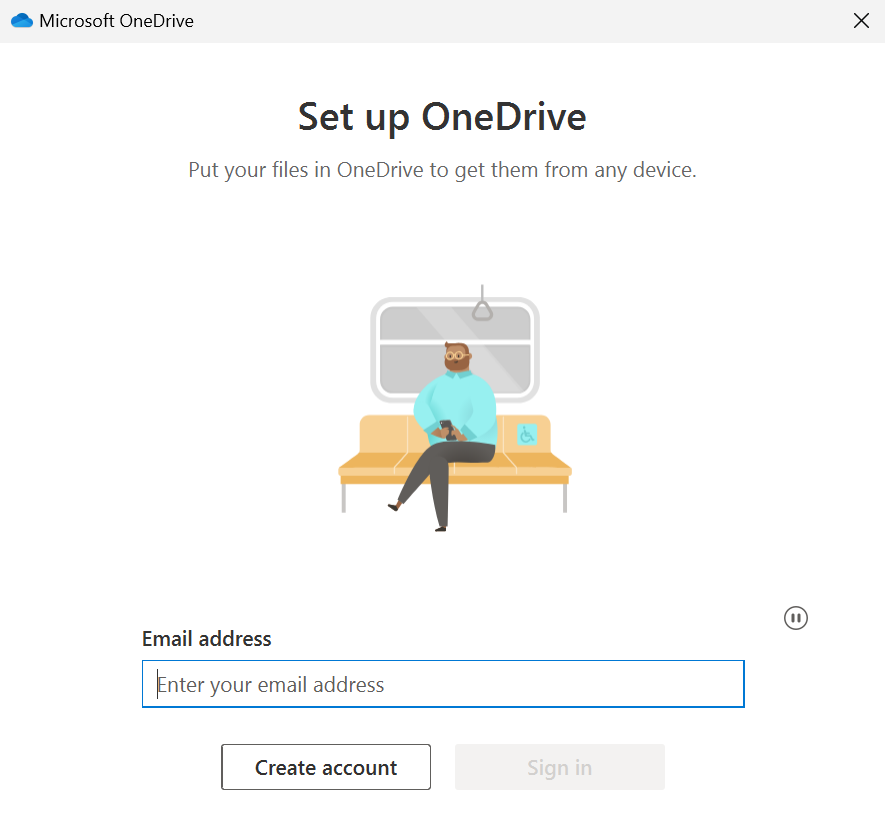
- If OneDrive has not been set up yet, you will be prompted to enter your email.

- Use your Bryn Athyn College Microsoft 365 credentials to sign in.
What is my Username and Password?
- Use your Bryn Athyn College Microsoft 365 credentials to sign in.
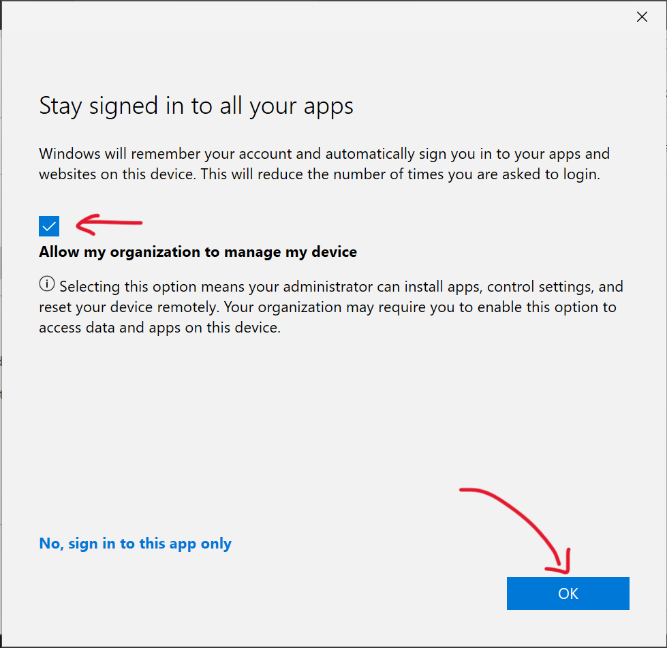
- Keep Allow my organization to manage my device checked, then click OK.

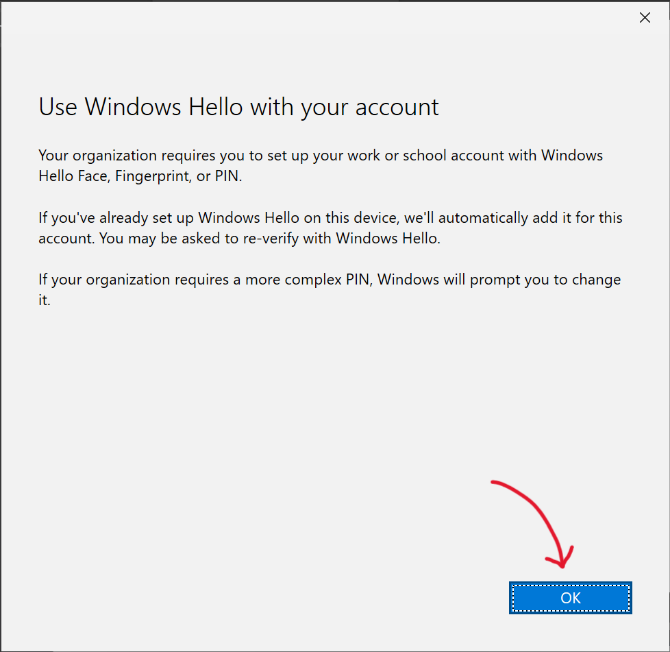
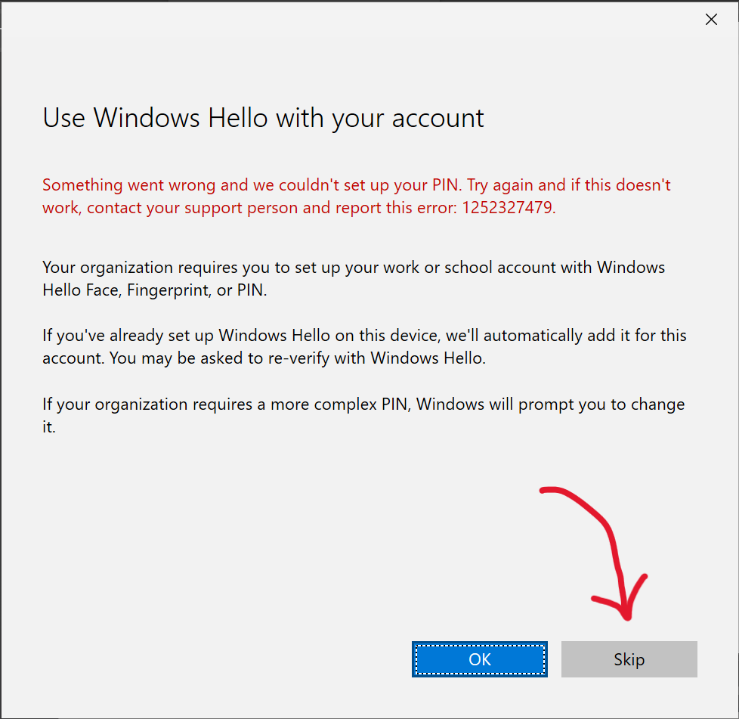
- When prompted to use Windows Hello, click OK.

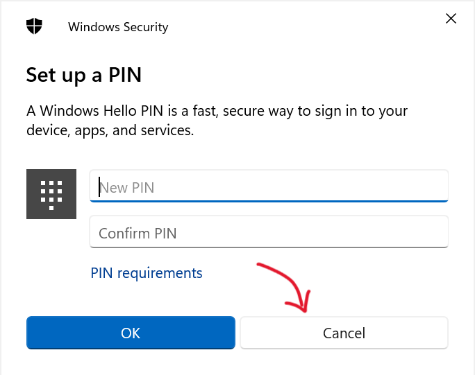
- If you're asked to set up a PIN, press Cancel.

- Click Skip.

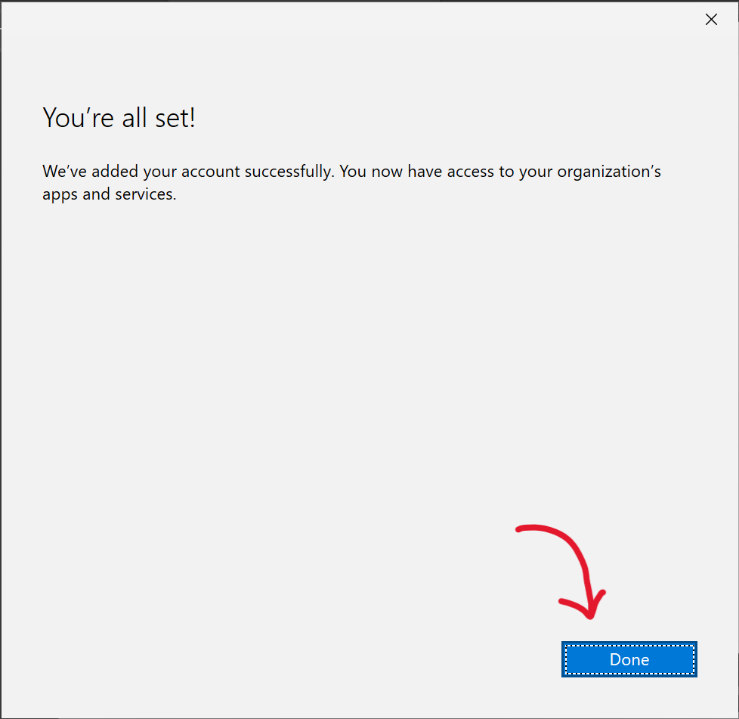
- Click Done.

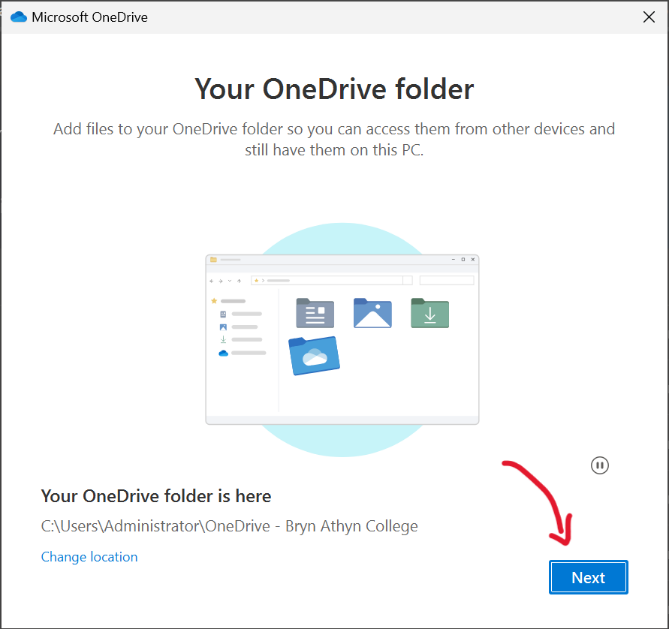
- Click Next.

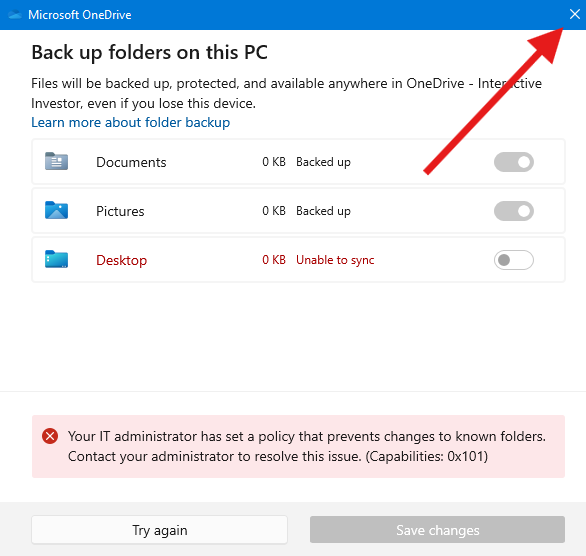
- Once you reach the Back up folders on this PC screen, press the 𐌗 in the top right corner to close the window.

If you're on a College-owned device, you will see an error that says
"Your IT Administrator has set up a policy that prevents changes to known folders."
This error can be safely ignored.
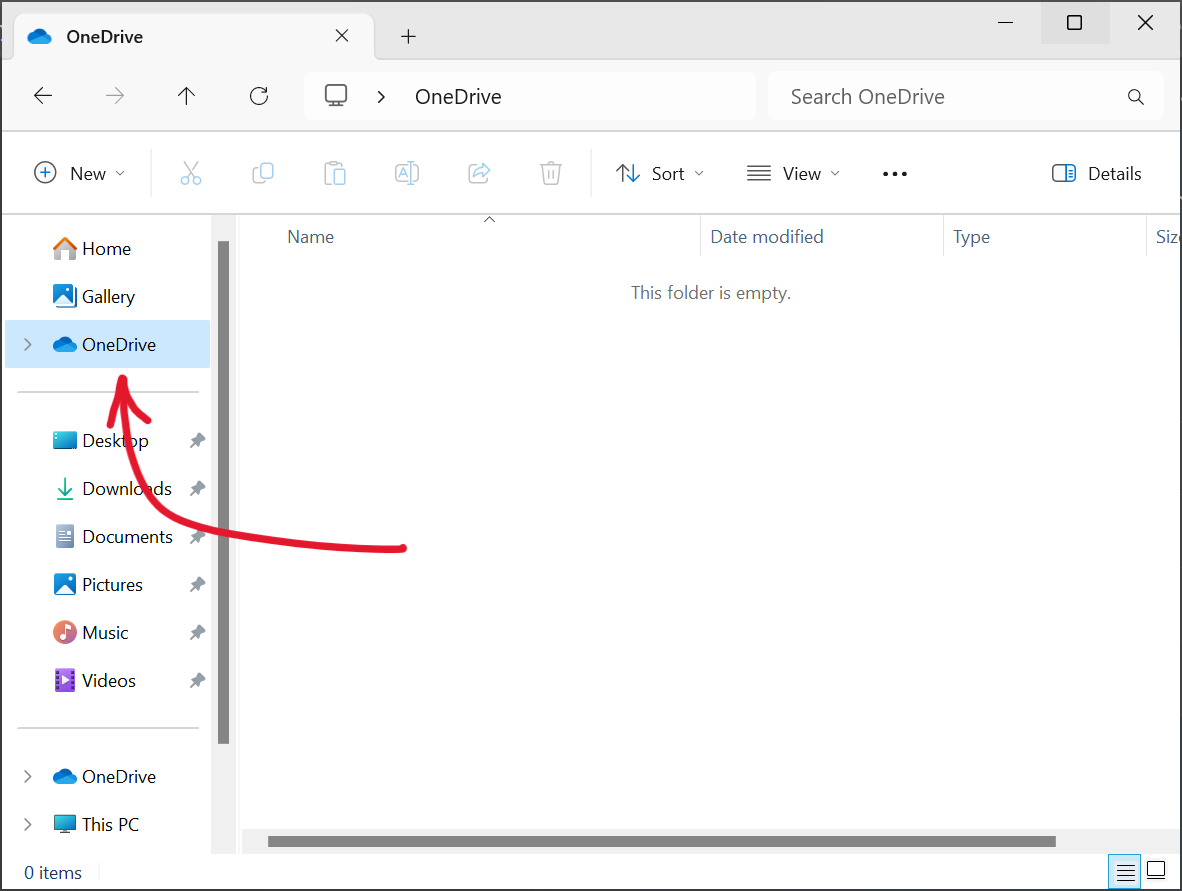
OneDrive is now set up.
If you use more than one account, your personal files appear under OneDrive – Personal and your work or school files appear under OneDrive – Bryn Athyn College.
macOS
- Download and install OneDrive for your computer from
microsoft.com/microsoft-365/onedrive/download - Start OneDrive Setup by pressing
cmd+Spaceto launch a Spotlight query and type "OneDrive". When prompted, enter your Bryn Athyn College Microsoft 365 account, and select Sign in.The OneDrive Sync app for macOS does not currently support adding two business accounts from different organizations if they share the same display name. Attempting to configure such accounts will result in a setup failure.
- There are a couple of points of OneDrive Setup that are helpful to watch for:
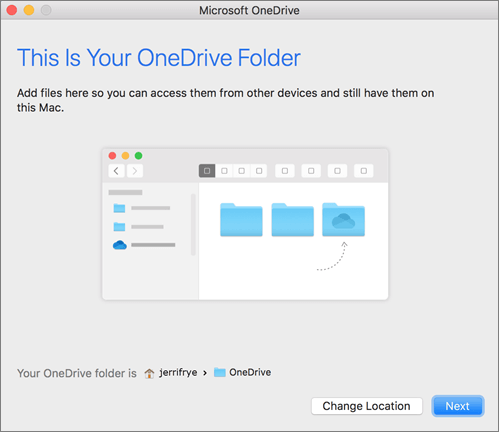
- When setting up your OneDrive, it has a default location set. However, you can change this during setup. On the This is your OneDrive Folder screen, click Change Location.

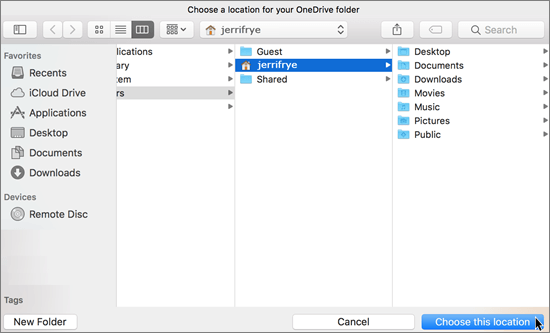
Select a location where you would like to save your OneDrive files and click Choose this location.
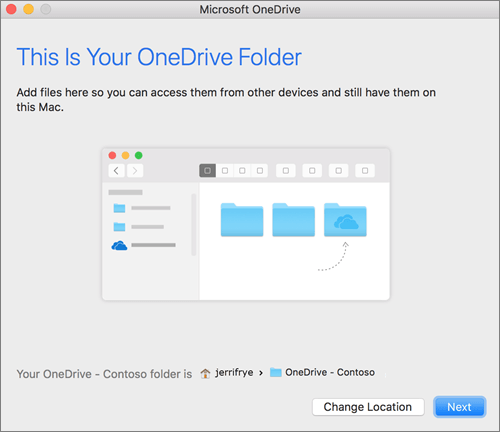
When you see the This is your OneDrive Folder screen, you'll now see a path to the folder you selected. Click Next to continue.
- On the Sync Files from Your OneDrive screen, you can choose the folders you want to sync to your computer and click Next. This conserves space on your computer, and reduces bandwidth needed for the sync processes.
- When setting up your OneDrive, it has a default location set. However, you can change this during setup. On the This is your OneDrive Folder screen, click Change Location.
- Once sync has completed, you can:
- Add another account. You can have multiple work or school accounts, but only one Personal OneDrive account. Learn more.
- Add Finder integration. If you're on OSX 10.10 or higher, get sync status directly from Finder by enabling Finder overlays in Settings.
- First, click the Apple logo in the top left corner of your Mac Desktop and select System Preferences.
- Select Extensions in the top-level menu.
- Toggle on the OneDrive Finder Integration to enable Finder overlays.
You're all set! Click Open my OneDrive folder to see your files sync to your folder.
If you use more than one account, your personal files appear under OneDrive – Personal and your work or school files appear under OneDrive – Bryn Athyn College.
Android
You can download OneDrive on an Android device via the Google Play Store.
iOS
You can download OneDrive on an iPhone via the Apple App Store.
Meeting on Teams
When scheduling a Teams meeting, you are given a variety of options. This page contains instructions for how to set up different kinds of Teams meetings.
Scheduling
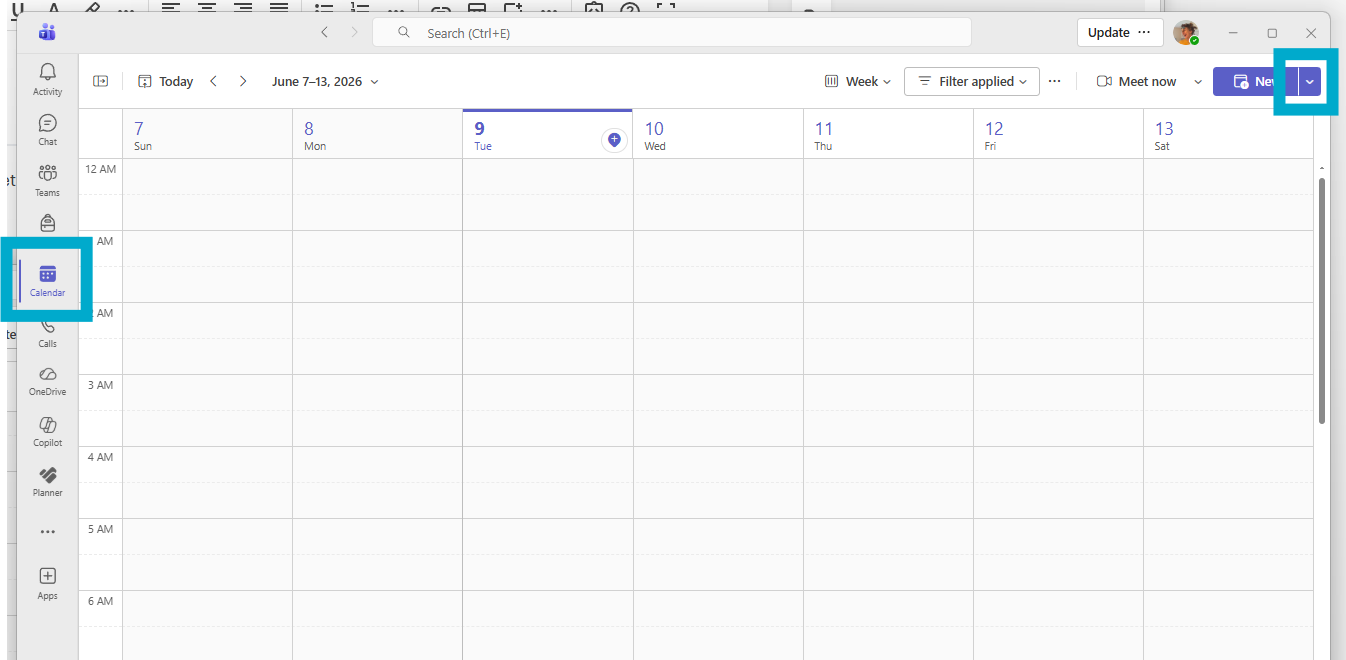
- Select the Calendar view.
- Select the drop-down arrow in the top right.

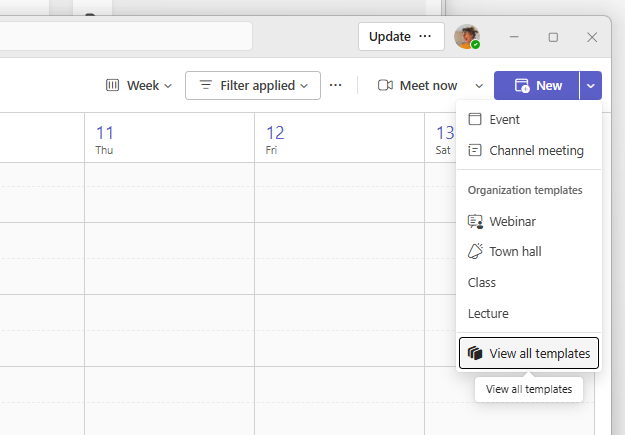
- Pick a template to use.

- View all templates will show the full list. Each is described in the section below.
- Fill in the rest of the basic information about the meeting (location, time, attendees, etc.), then send the invite.
Types
Channel meeting
Choosing Channel meeting will create a basic Teams meeting where participants can discuss with each other. This is the best option for one-on-one or group conversations.
Live event and Town hall
Live events and Town halls support a massive number of viewers connecting to watch content live from the host. Viewer participation is under the control of meeting organizers for managed Q&A and similar interaction. These are best suited to public presentations. The main difference is that in Town Halls participants are strictly limited to no microphone or camera, whereas in Live Events input permissions can be changed.
Webinar
Webinars are similar to live events, but have advanced features both for pre-registering attendees, and for managing multiple presenters. This is ideal for when presenters are attending from multiple locations.
Lecture and Class
Lectures and Classes are very similar to meetings, but have a few additional options to limit which participants can present, use their mics, text chat, etc. The only difference between the two is that classes have chat set to only during the meeting, whereas lectures default to having the chat available outside the meeting.
Setting up Outlook on mobile
If you forget your email address and/or password, see What is my Username and Password?
- Scan a QR code to download the Outlook app from the Apple App Store or Google Play Store.


- Tap Add Account.
- Enter your college email address.
- Select Office 365 as your account type or email provider.
- Enter your Microsoft account password, then click Sign in.
- Approve your sign in request via Authenticator when prompted.

You now have access to your college email on the go!
Encrypting messages in Outlook
All students, faculty, and staff should have the ability to send encrypted emails. This page details how to encrypt your message and how to view an encrypted message in Outlook.
Background
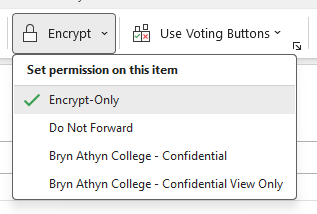
Microsoft offers a few different levels of encryption. This is an outline of what the different levels do (all levels are securely encrypted):
- Encrypt-Only is the default, it means the message is encrypted in transit and the recipient will have to authenticate with their email to view the message, or use a one-time code sent to their email to authenticate.
- Do Not Forward disables the forward option and disables printing. Of course, this doesn’t disable screenshots or the user’s ability to take a picture with their smartphone.
- Bryn Athyn College – Confidential means the recipient won’t be able to open the message in a non-Bryn Athyn College/GC Outlook client. This is in case someone is having their work email forwarded to a personal email.
- Bryn Athyn College – Confidential View Only is the same as above, only the content cannot be modified or replied to.
If you wish to send an encrypted message, we recommend setting up the encryption before writing your message. That way, if you accidentally send the message before you are done typing it, it will still be encrypted. Additionally, you can send this link from Microsoft that explains how end users can open a protected message: https://support.office.com/en-us/article/how-do-i-open-a-protected-message-1157a286-8ecc-4b1e-ac43-2a608fbf3098
Instructions
These instructions were created with the Outlook desktop app. If you're encrypting on the Outlook web version, the instructions remain the same, although the buttons may look slightly different.
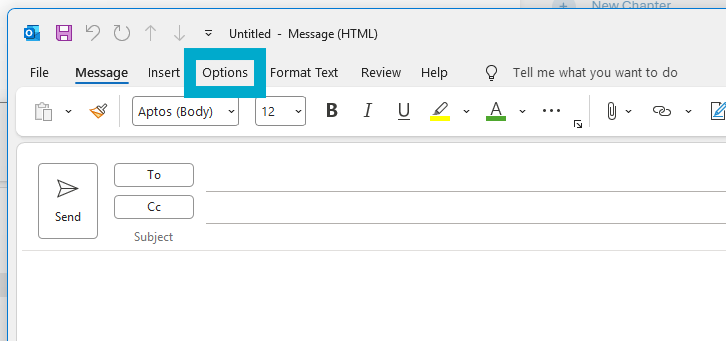
- Create a new email. In that email select the Options tab at the top.

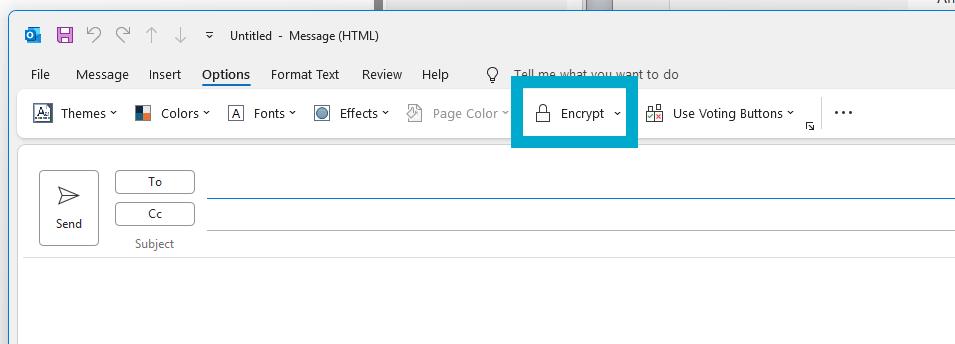
- Select Encrypt.

- Optionally, choose your encryption level from the drop-down menu.

You may have to click Encrypt first for the dropdown to appear correctly if this is your first time encrypting a message.
- Write and send your message!
Viewing
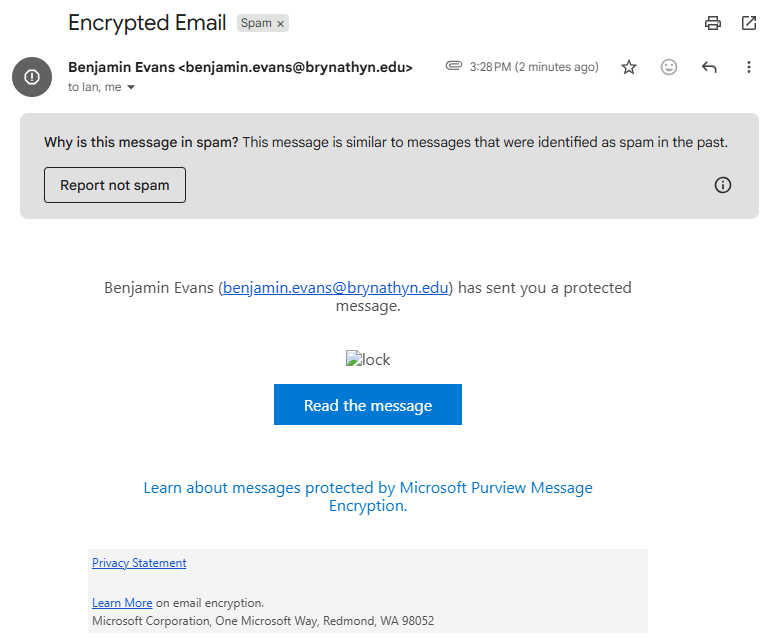
For anyone with a Bryn Athyn College email, viewing an encrypted email will be the same as opening any other email. If you’re sending an encrypted email to someone outside of Bryn Athyn College, like to a Gmail address, the recipient must go through the Microsoft Purview portal to read it:
- Locate the email.

When received, it may automatically go into the recipient's spam folder.
- Once the recipient clicks on Read the message, they will be taken to a login page.
- Here they can either log in with their personal email account (e.g.
<name>@gmail.com), or use the One-time passcode option to sign in.
- Here they can either log in with their personal email account (e.g.
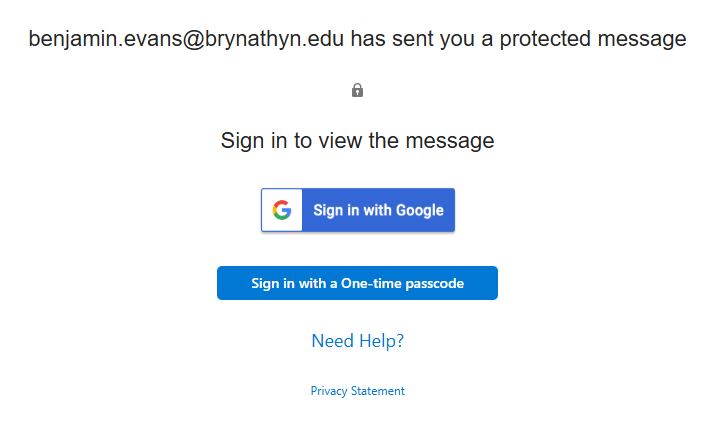
They will then be able to view the contents of the message.
Reporting messages in Outlook
Use the Report Message drop down to select from a couple ways to deal with phishing or junk mail. These features help Microsoft keep your information safe and your inbox filled with only important emails. For more help with managing Junk/Spam emails, see the Microsoft Support page.
Instructions
The screenshots below will match the Outlook website and the modern version of the desktop app. If you use the old version (Outlook Classic) on your desktop, the buttons may be in different locations.
- In the Home tab, click the Report button with the dropdown arrow.

- With the message you want to report highlighted, click Report junk or Report Phishing. See Junk and Phishing at the bottom of this page if you don't know which to select.

- Click Report to confirm.

- The message will be moved to your Junk Email folder. After 30 days there, it will be deleted.
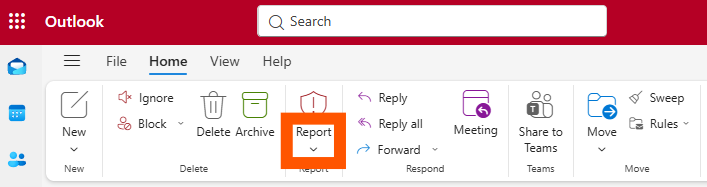
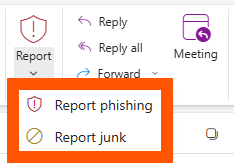
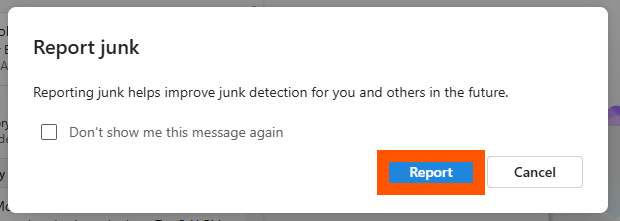
When you report a message, a copy will be sent to Microsoft to update spam filters, and all future messages from that sender will be sent directly to the Junk Email folder.
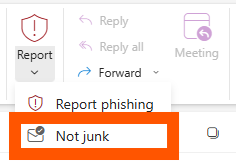
If you reported a message accidentally and wish to restore it:
- Find the message in your Junk Email folder and select it.
- Click the Report dropdown.
- Click Not junk.

Junk
These are messages that you don't want to receive. For example, they may be advertisements you don't care about or find offensive. Junk emails are annoying, but not necessarily malicious.
Phishing
Phishing is the practice of luring you into disclosing personal information, such as bank account numbers and passwords. Often phishing messages look legitimate but have deceptive links that open fake websites. Phishing emails are always malicious, but not necessarily annoying.
Sharing files with OneDrive
OneDrive allows you to give anyone access to files you choose to share. You can configure the share to allow people to see or edit the files without a Microsoft account. Optionally, this can be done with extra security measures like expirations dates, file passwords, and email verification.
Instructions
- Head to My files - OneDrive and sign in with your BACNC Microsoft 365 account.
What is my username and password? - If the file(s) or folder isn't already on OneDrive, click Create or upload to upload them.
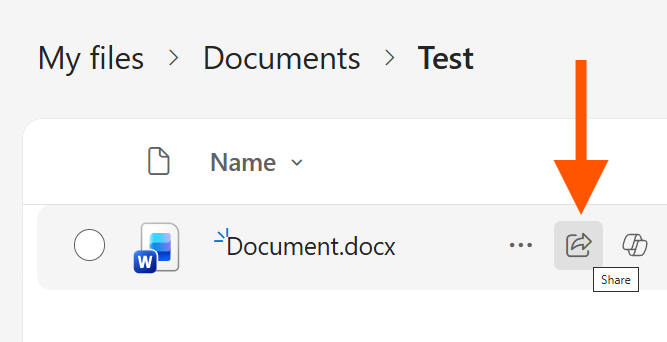
- Hover over the file / folder and click the Share icon

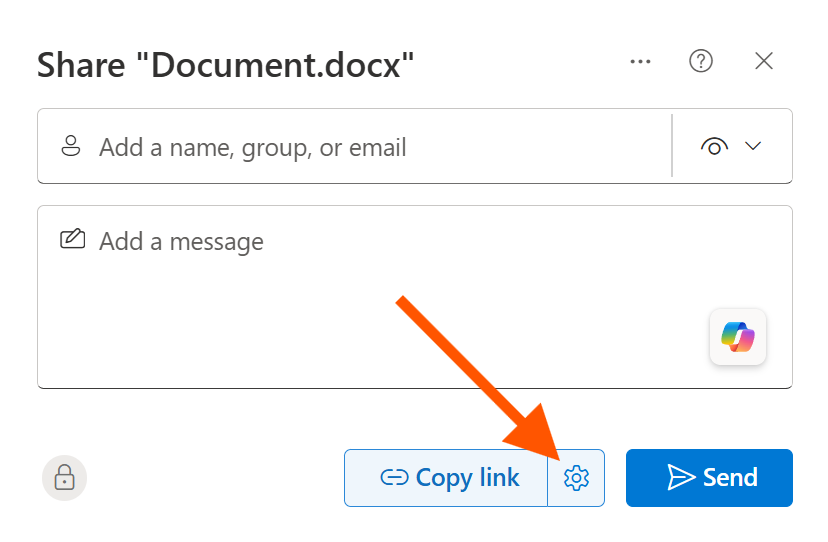
- Click the settings gear next to Copy link.

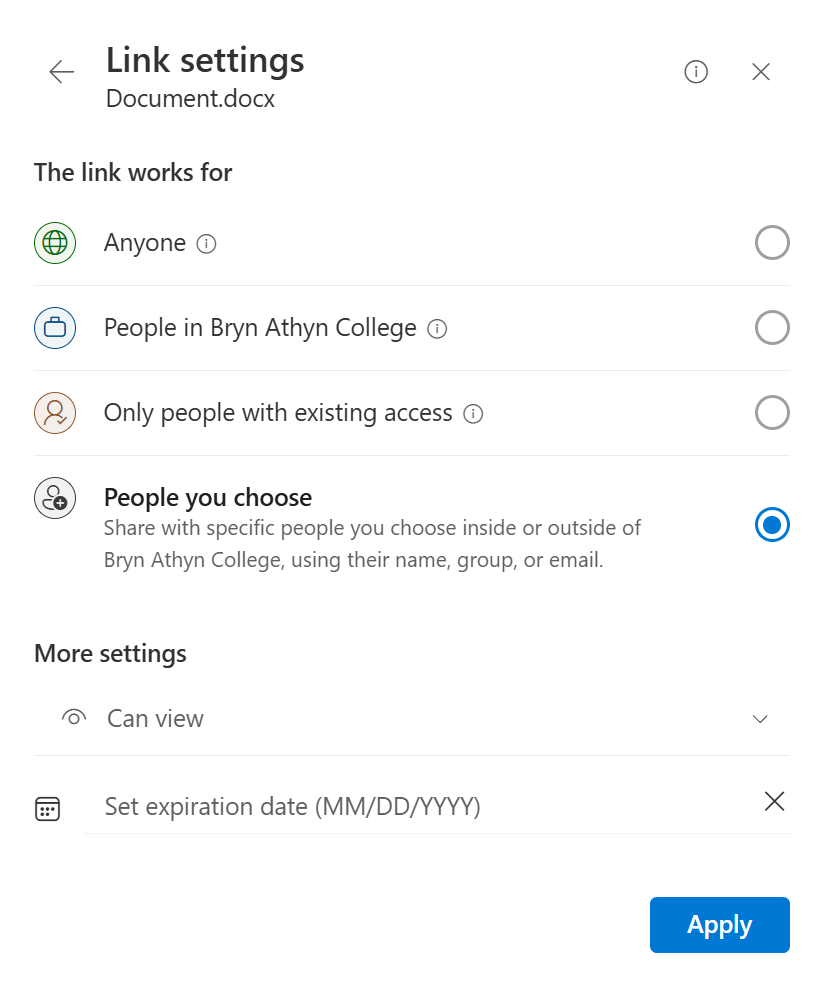
- Choose an access level in the Link settings popup.

- Anyone allows for access without a Microsoft account.
- People in Bryn Athyn College only works for users with organization accounts.
- Only people with existing access inherits the permissions that already exist for that file.
- People you choose allows you to input email addresses to share with.
- Anyone allows for access without a Microsoft account.
- Change the edit permissions in the dropdown under More settings to your desired option.
- Optionally, set an expiration date and password for the share (extra security).
- Click Apply.
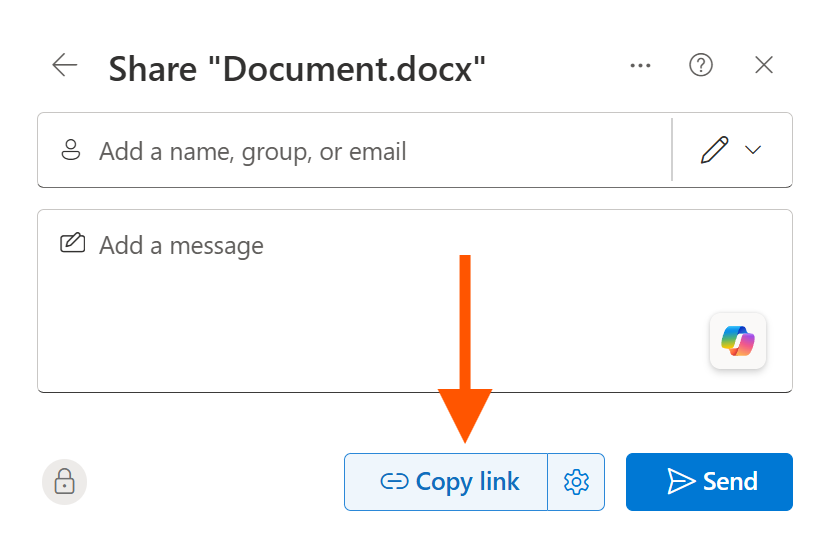
- Click Copy link and send it to whoever needs access.